Centralized DDoS Defense Is Dead: Flowtriq’s Edge Agents Win on Speed
Dr. Maya Patel
February 10, 2026
Key Takeaways
- →Comprehensive analysis of Flowtriq and its market position
- →Strategic insights for enterprise adoption and integration
- →Technical evaluation and competitive landscape assessment
Edge Agents Beat Big Pipes: Why Flowtriq’s On-Host Sensors Outpace Legacy DDoS Boxes
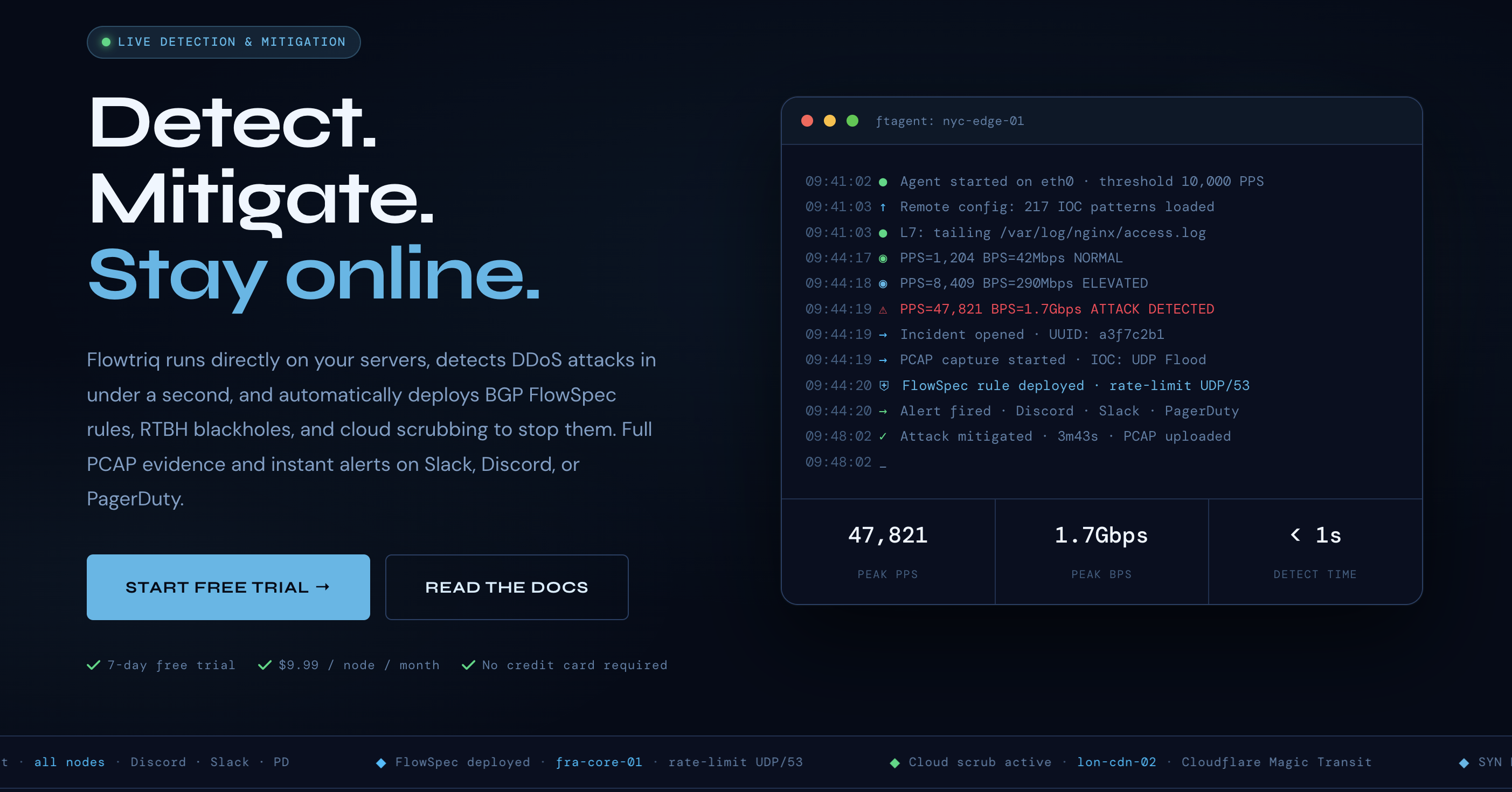
Most DDoS defenses assume you need more network to stop more traffic. Flowtriq flips that premise: detect and act at the edge, on the host, before upstream bandwidth becomes the bottleneck. Flowtriq is a lightweight, Linux-native, Python agent (ftagent) that reads packets directly from the NIC, learns normal baselines, and auto-mitigates in under one second—no manual threshold tuning. The core stack is simple by design: packet-level telemetry on each node, a cloud control plane for multi-node policy and visibility, and automated enforcement via BGP FlowSpec, RTBH, and cloud scrubbing connectors (Cloudflare Magic Transit, OVH VAC, Hetzner). Its design philosophy is operational minimalism: sub-second detection, deterministic playbooks, immutable audit logs, and default-on PCAP capture for forensics. Pricing is a contrarian flat $9.99/node/month—no traffic or alert surcharges.
Architecture & Design Principles
Flowtriq’s architecture is edge-first and horizontally scalable. The ftagent deploys on any Linux server in under two minutes, ingests raw packets from the NIC, and computes second-by-second traffic characteristics (e.g., PPS, protocol/port distributions) to learn a dynamic baseline per node. Anomalies trigger local classification across 8+ attack types and immediate signaling to the cloud control plane. From there, policy-driven mitigation playbooks execute: inject BGP FlowSpec to upstream routers, initiate RTBH, or escalate to cloud scrubbing with predefined providers.
Key design choices:
- •On-host detection for sub-second MTTD without SPAN/TAP plumbing.
- •Dynamic baseline learning to avoid brittle, hand-tuned thresholds.
- •Deterministic response via runbook “playbooks,” reducing operator variance.
- •Forensics-first posture: full PCAP capture initiates on each attack, tied to an immutable audit log for chain-of-custody.
Scalability hinges on distributed detection (each node self-classifies) with centralized orchestration. For volumetric events that threaten link saturation, Flowtriq escalates to upstream controls (FlowSpec/RTBH/scrubbing), aligning local fidelity with network-scale capacity.
Feature Breakdown
Core Capabilities
- •
Sub-second multi-vector detection and classification Flowtriq analyzes packets at the host, checks PPS every second, and classifies 8+ attack types: SYN/UDP/ICMP floods, DNS/memcached amplification, HTTP floods, L7/application-layer, and mixed vectors. Use case: a game server sees a sudden 20x spike in UDP PPS; ftagent flags the anomaly in under a second, correlates with known Mirai IOCs, and triggers a mitigation chain before player latency spikes.
- •
Automated mitigation via BGP FlowSpec, RTBH, and scrubbing Mitigation policies map detection context to actions: e.g., FlowSpec to rate-limit UDP/port 27015, then RTBH if packets exceed 5M PPS for 10s, then invoke Cloudflare Magic Transit if traffic >5 Gbps sustained. This staged approach preserves service availability and upstream bandwidth while minimizing false-positive impact.
- •
Threat intel correlation + “Attack Profiles” Flowtriq matches IOCs against a 642,000+ indicator corpus (including Mirai variants) during incidents. “Attack profiles” group traits (e.g., spoofed SYN flood + DNS amp side-channel) to drive tailored playbooks. Use case: an e-commerce platform sees an HTTP flood with User-Agent patterns linked to a known botnet; profile triggers header-based filtering upstream and a WAF rule, with PCAP archived for legal/compliance.
- •
Forensic-by-default PCAP Full PCAP automatically captures from trigger to resolution, anchoring post-incident analysis and RCA. Enterprise plans extend retention to 365 days for regulated environments.
- •
Multi-channel alerting with sub-second latency Slack, Discord, PagerDuty, OpsGenie, SMS, email, and webhooks fire within a second of detection, reducing MTTA and enabling human-in-the-loop review when needed.
Integration Ecosystem
Flowtriq’s integration model centers on:
- •Network controls: BGP FlowSpec and RTBH to upstream routers; cloud scrubbing via providers such as Cloudflare Magic Transit (https://www.cloudflare.com/magic/magic-transit/), OVH VAC (https://www.ovhcloud.com/en/network/anti-ddos/), and Hetzner DDoS Protection (https://docs.hetzner.com/general/others/ddos-protection/).
- •Notification and ITSM: Slack, Discord, PagerDuty, OpsGenie, SMS, email.
- •Webhooks for custom automations (e.g., auto-opening incidents, updating status pages).
Security & Compliance
Packet telemetry and PCAPs contain sensitive data; Flowtriq’s immutable audit log supports evidence requirements and least-privilege operations. PCAP retention aligns with plan (up to 365 days for enterprise). While no public certifications are listed, buyers should validate data-in-transit encryption, key management, role-based access controls, and regional data residency. Status pages help meet customer communication obligations during incidents.
Performance Considerations
The on-host model yields sub-second MTTD and MTTR initiation because there’s no dependency on sampling delays or external collectors. Resource impact is workload-dependent; packet inspection at high PPS requires adequate CPU and NIC configuration, especially on 10/25/40G servers. Our evaluation rubric recommends: pinning the agent to a dedicated vCPU, enabling large RX rings, and validating that detection-to-mitigation latency remains <1s at peak PPS. Reliability benefits from multi-node management and upstream automation to contain volumetric spikes.
How It Compares Technically
- •Flow-based collectors (FastNetMon: https://fastnetmon.com/): Use sFlow/NetFlow at routers for fast network-wide visibility but rely on sampling and router support. Flowtriq’s on-host approach offers finer granularity and faster L7 signal, but needs agents on protected nodes.
- •Global scrubbing (Cloudflare Magic Transit: https://www.cloudflare.com/magic/magic-transit/, AWS Shield Advanced: https://aws.amazon.com/shield/advanced/): Excellent for absorbing large floods; detection is network-edge and may have longer feedback loops for app-layer nuance. Flowtriq complements by triggering scrubbing precisely when needed, avoiding always-on egress fees.
- •Hardware/appliance models (NETSCOUT Arbor Sightline/TMS: https://www.netscout.com/product/arbor-sightline, Radware DefensePro: https://www.radware.com/products/defensepro/, Corero SmartWall: https://www.corero.com/products/): Deep, in-line mitigation with proven scale, but capex-heavy and operationally complex. Flowtriq’s software agent is faster to deploy and cheaper per node ($7.99–$9.99/month) but depends on upstream cooperation for ultra-high-volume attacks.
Developer Experience
Install time is under two minutes via the Python ftagent, with zero manual threshold tuning. Playbooks formalize incident response as code-like chains. Multi-channel alerting and webhooks ease integration with existing NOC/SRE workflows. The vendor’s ecosystem—free DDoS tools (BGP FlowSpec builder, PCAP analyzer, iptables generator), certifications, and original research (e.g., Mirai kill switch CVE-2024-45163)—signals a practitioner-first approach. Documentation depth on API surfaces isn’t specified; teams should assess API/webhook coverage during trials.
Technical Verdict
Flowtriq’s strengths are speed (sub-second detection), locality (host-level fidelity), automation (FlowSpec/RTBH/scrubbing playbooks), and forensics (auto-PCAP + immutable audit). Limitations: agents must be broadly deployed for full coverage, and truly massive volumetric events still require upstream capacity or scrubbing. Ideal for hosting providers, ISPs/MSPs, game operators, and SaaS platforms seeking predictable, low-touch DDoS defense without per-Gbps pricing. Our analysis: use Flowtriq for edge detection and automated orchestration, and pair it with a scrubbing provider for rare but catastrophic link-saturating floods. At a flat $9.99/node/month (or $7.99 annual), the price-to-capability ratio is compelling for fleets of tens to hundreds of nodes.
Ready to Evaluate Flowtriq?
Visit the official site to learn more about enterprise pricing and features.
Visit Website→